
Terrace restaurant decoration is the deliberate arrangement of outdoor dining space to balance hospitality, weather protection, and daily practicality.
The difference between a terrace that earns year-round and one that sits empty usually comes down to whether the layout can shift on a Friday night without a crew.
A single propane heater placed for symmetry rather than where guests actually sit will leave perimeter tables in jackets, and string lights marketed as outdoor-grade will corrode in their first steady rain.
Segmenting Space for Better Hospitality
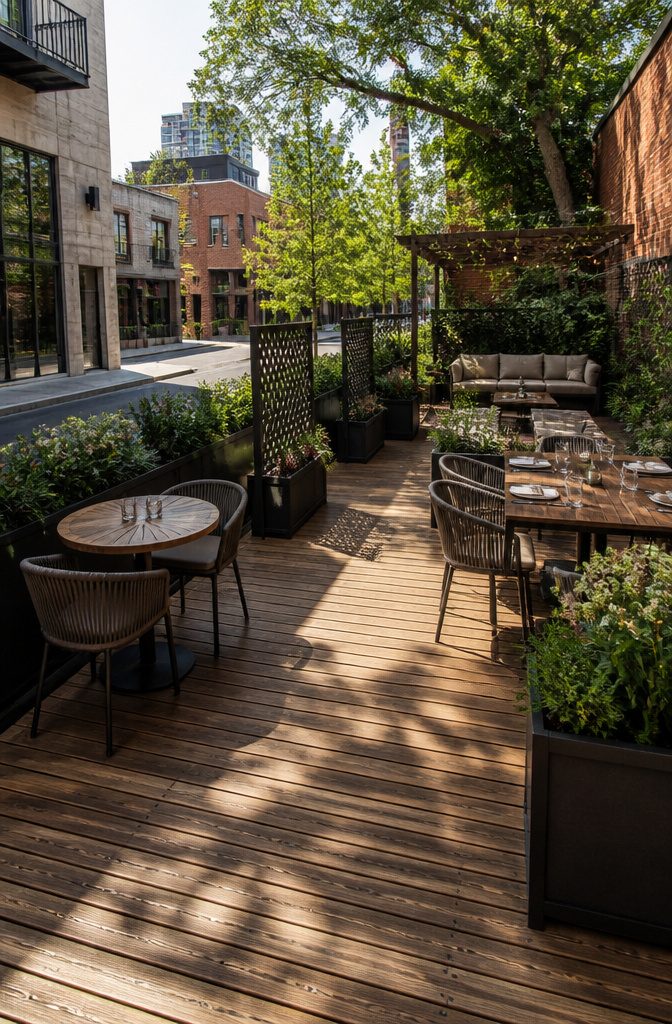
A terrace that reads as one flat surface usually feels like a parking lot with chairs.
Dividing it into zones lets a couple on a date and a six-top birthday group both feel like the space was designed for them, without either one eating in the other’s lap.
Planters, light screens, and plant boxes do the heavy lifting here.
They mark where one zone ends and another begins without building walls that block airflow or sightlines. Trellises and vertical gardens work the same way, adding height that defines space naturally while still reading as open.
A pergola or awning over one corner can signal "dining room" against an uncovered stretch that stays "patio lounge," and you can move it or lose it if the layout needs to change.
I went the temporary route on a project last year because the lease had two years left and the owner was not about to pour concrete for built-ins.
Three rolling planter boxes, two folding screens from a restaurant supply site, and a freestanding trellis with a weighted base gave us four distinct zones: two-tops near the street, a four-table group section, a standing bar area with high stools, and a small lounge with a couch and coffee table for waits and aperitifs.
Staff could walk the full loop without cutting through seated guests, and when the event next door needed extra capacity, two screens folded flat in ten minutes and the lounge became overflow dining.
The mistake I nearly made was sizing everything too big.
A six-foot planter feels generous until it leaves no aisle for a tray. Keep at least enough room between tables for easy movement, and treat every partition as something that might need to shift on a Friday night.

MOBILE GARDEN ON WHEELS — Two all-terrain wheels and an ergonomic handle let you roll a 200+ lb planted bed wherever sunlight goes. Move your garden across patio, balcony, or backyard in minutes.

【PLANT CADDY WITH DRAINAGE & LOCKABLE WHEELS】Includes 4 lockable rolling saucer designed for easier movement and cleaner plant care. The textured inner surface helps elevate the planter slightly to promote excess water drainage, while the built-in bottom tray helps collect runoff and protect patios, porches, balconies, and indoor floors from messes. Smooth-rolling wheels with locking casters make it simple to reposition large plants while keeping them securely in place when needed.

Built to Last: 330 lbs Heavy-Duty Capacity. Our tree planters are crafted from premium powder-coated steel—which eliminates the risk of warping, cracking, or snapping under pressure. With a robust load capacity of 330 pounds, ensuring your olive trees,shrubs, or seasonal arrangements are safe and secure year-round
Materials, Colors, and Lighting for a Welcoming Atmosphere
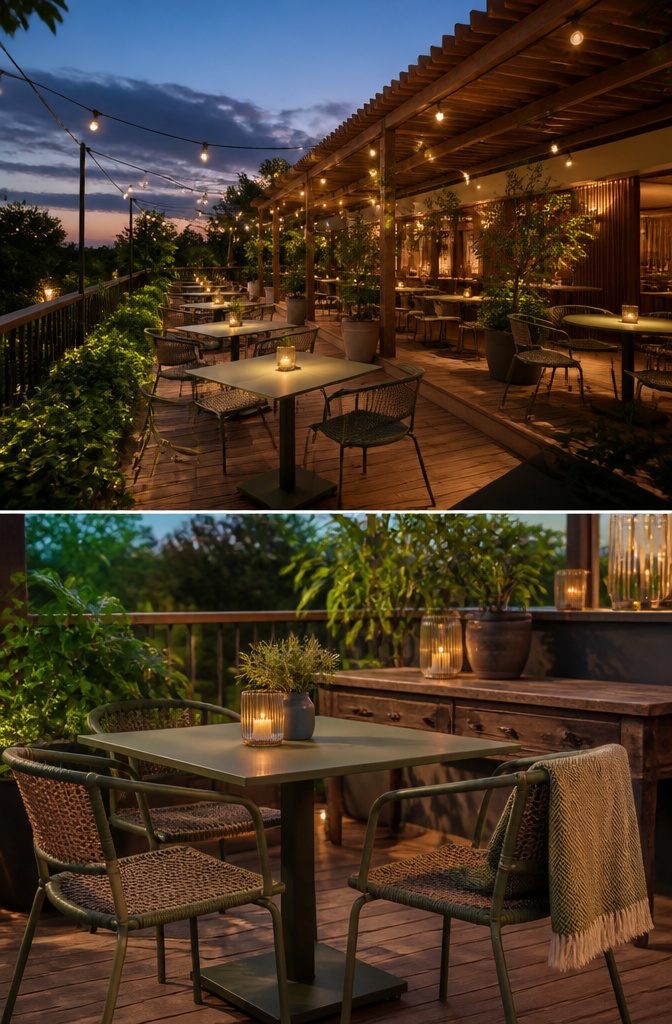
Natural textures and a restrained palette do more work than loud color ever could on a terrace.
Wood, powder-coated metal, and aluminum hold up against weather and UV exposure while still reading as warm, not industrial. Raw wood paired with iron fittings leans into that rustic countryside feeling that keeps people lingering past dessert.
Cushions soften the edges, but they need to be moisture-resistant or they become a storage headache the first time a storm blows through.
Lighting is where I blew it the first time around. String lights marketed for outdoor use died in the first real rain, not even a downpour, just a steady two-night soak.
The sockets corroded, and half the strand went dark. I swapped them for solar lanterns and small bulbs mounted under trellises, which keep the glow low and the hardware shielded.
The rule I follow now: any fixture on an open terrace needs a physical cover, not just an outdoor label.
Spotlights have their place for architectural accents, but the atmosphere comes from softer sources. Candles, lanterns, and gentle accent lighting pull evening service away from the dining room and out onto the terrace without feeling like a stage set.

【Moveable Privacy Screen】DURASPACE weave fiber room divider helps create extra privacy. Not only suitable for indoor room privacy, but also for outdoor porch privacy. Use this folding wall divider to separate sections of different space. You gain privacy and divide areas of your home.

Japanese-inspired room divider for creating privacy in small spaces, lightweight but stable frame made of wood with black finish

Stable Structure: Our Room Partitions and Dividers is made of strong steel frame with powder coating, which is not easy to scratch and rust, extending the service life. Extra Longer and Wider Feet pads fits more easily to the ground and improve the stability of the room divider and not easy to shake and fall
Furniture That Balances Comfort, Durability, and Consistency
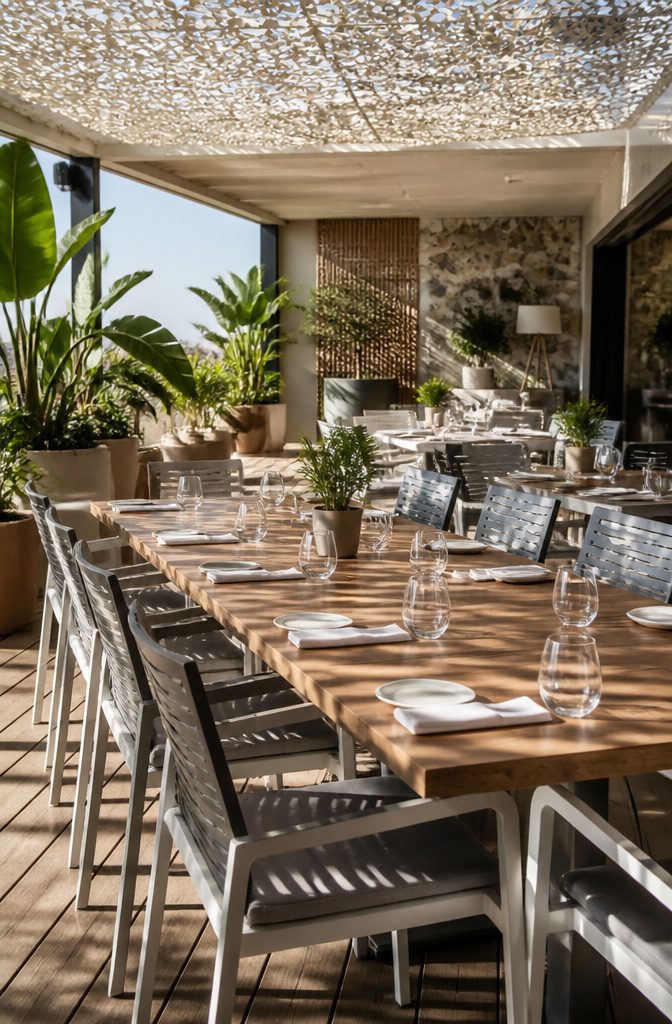
Teak holds up longer than anything else I have handled for outdoor restaurant seating, though it asks for maintenance to keep that honey color.
Aluminum costs less upfront and moves easier, which matters when servers are clearing a terrace after last call.
Cane and bamboo read warmer on the eye and weigh almost nothing; I would use them for the visual break they provide, not for the chairs that take daily abuse.
Stackable chairs saved my storage situation on a project where the only lockup was a basement stairwell.
The difference between a two-minute breakdown and wrestling fixed-frame seating through a narrow door adds up every night of service, and it shows in how willing the floor staff are to follow the closing routine.
Sizing the mix matters as much as the material. Two-tops along the railing for couples, four- and six-tops in the middle for groups, maybe one long bench that flexes to a party of eight.
Keeping the frames consistent in finish or silhouette keeps the terrace from reading like a yard sale, even when the table shapes vary.

200FT Extra-Long size:Most string lights on the market are only 50-120ft size,For large yards,pool sides,or long fences often require multiple strings to be connected,resulting in tangled wires and potential poor contact.Our 200ft extra-long string light can wrap around an entire tree,cover an entire patio,or even illuminate a medium-sized garden with one string lights,no splicing needed,Installation is time-saving,making the decor looking seamless and attractive.

[8 Lighting Modes]: WATERGLIDE 2 pack 50LED Halloween orange and purple mini string light has 8 lighting modes for you to choose - Combination, In waves, Sequential, Slow Glow, Chasing/Flash, Slow fade, Twinkle/Flash, Steady on. Adjust the lighting modes by pressing the round button on the battery box

INCLUDES - 40 Clear Command Outdoor Light Clips and 48 Small Command Water-Resistant Strips
Year-Round Terrace Use
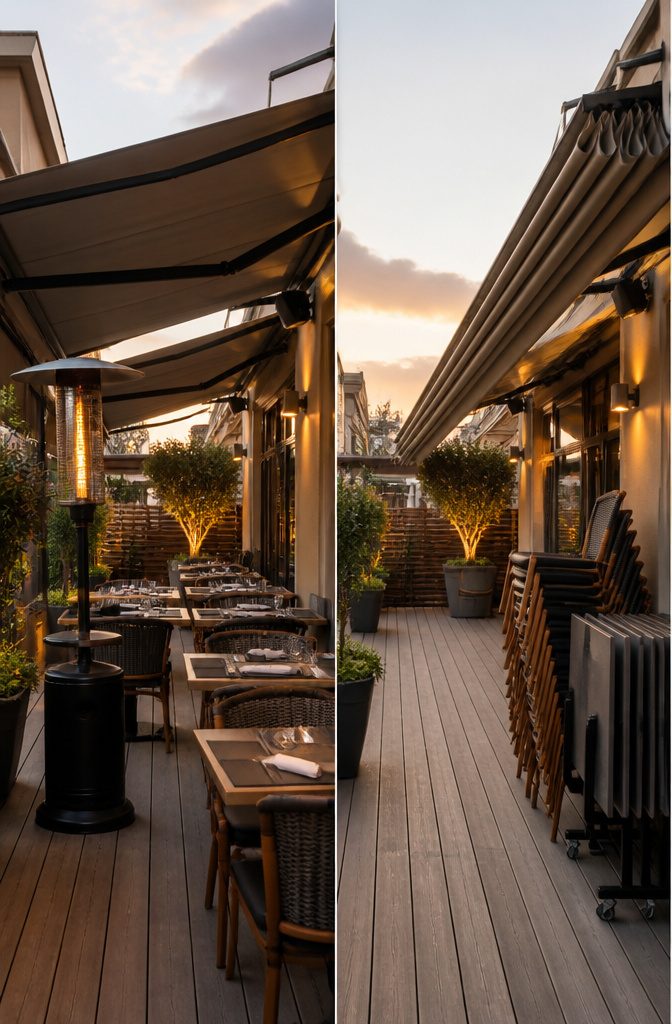
Heaters make the difference between a terrace that earns its keep three months a year and one that pays rent through October.
I started with a single propane mushroom heater centered over the main seating area, the kind restaurants buy by the pallet.
It warmed the people directly beneath it and nobody else. Guests at the perimeter tables kept their jackets on, and the staff started rotating reservations toward the middle without being asked.
That was the first lesson: one powerful source beats one weak one, but placement has to follow where people actually sit, not where the floor plan looks symmetrical.
Side awnings and retractable canopies came next.
The sources mention these as protection without full enclosure, and that balance mattered more than I expected. A complete enclosure turns a terrace into a greenhouse by day and a condensation trap by night.
I tried a fixed canopy first, ran it for two weeks, and watched afternoon sun turn the covered section into dead space. The retractable version cost more upfront and got used constantly; the fixed one became storage for spare chairs.
Misters for summer cooling sound clever until you account for local water hardness.
Mine scaled up inside a month. The blankets-and-cushions approach the sources suggest works better, costs less, and stores in a plastic bin when the weather turns.
Furniture rated for professional outdoor use survived where my residential-grade experiment warped in one season. The commercial label is not marketing; it is a warranty that somebody else already tested.

High-Power 48,000 BTU Fast Heating: Our Sweetcrispy outdoor heaters for patio out powerful instant warmth covering an 18-foot diameter area. Perfect for backyard gatherings and calm camping nights, it comfortably fits 4–8 people so you can stay outdoors all cool season long

SOOTHING WARMTH: Outdoor gas heater for cozy warmth when sitting outside; ideal for cafes, restaurants, and home patios

High-Efficiency Heat Output: Featuring powerful 11,000 BTU heat output and fast heating function, this tabletop patio heater can instantly drive away coldness and keep you toasty outdoors. Furthermore, 2.5 ft wide heating radius and 360° all-direction heating enable the heater to bring warmness to more people.
Layout That Survives Daily Wear
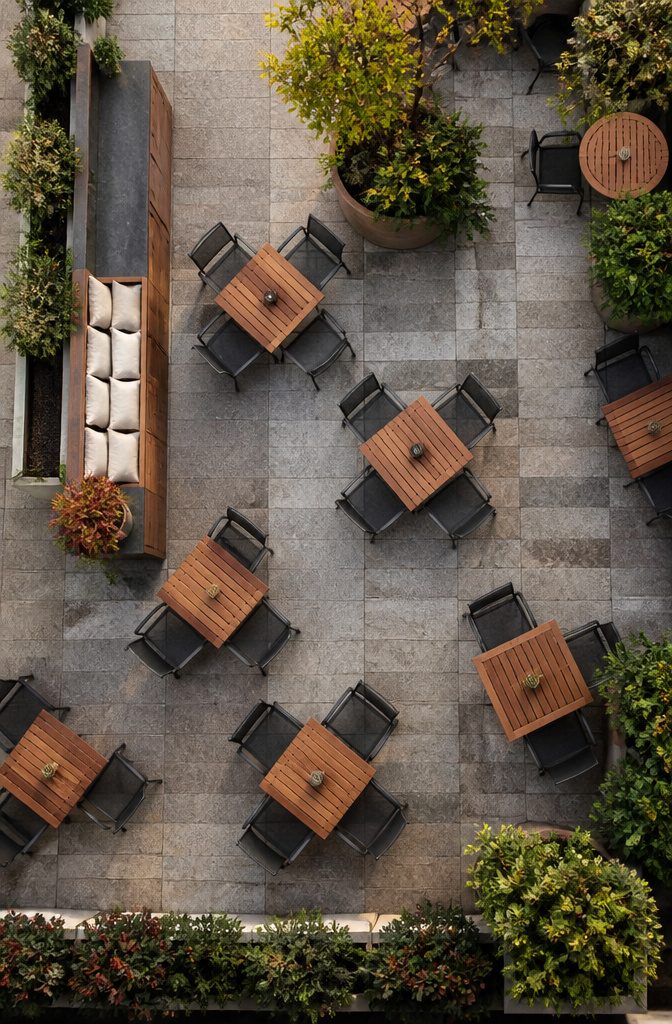
Stackable chairs and folding tables are the only layout choice that makes sense if you are the one setting up at 10 a.m. and breaking down after last call.
I have watched staff spend forty minutes wrestling with furniture that looked great in the catalog but fought back every single night.
The pieces that survive daily wear are the ones one person can carry without a second set of hands.
Cushions need a home that is not the floor. A bench with discreet storage underneath, or a narrow cabinet tucked behind a partition, keeps the setup looking intentional instead of improvised.
The same logic applies to the floor itself: exterior tiles or compacted pebble surfaces let a broom and a hose do the work of an hour’s scrubbing.
Smooth circulation for servers and customers matters more than squeezing in one extra table. A tight aisle means spilled drinks, slow turnover, and staff who dread the shift.
Lightweight materials like cane or bamboo frames move without the groan of solid teak, though they still need a dry corner for the off-season.
The maintenance angle is not an afterthought; it is what keeps the terrace looking like a terrace instead of a storage problem wearing a tablecloth.

Perfect Comfort and Support: Our outdoor chair cushions set of 4 pieces measure 18.5" x 16" x 2", offering a perfect fit for most patio and lawn chairs. Filled with 28D high resilience foam, they provide excellent elasticity and support, relieving pressure on your lower back, hips, and sciatic nerve, making them ideal for extended use.

Patio Chair Cushions Set of 4 - Designed for relaxation, our outdoor furniture cushions feature 30D high-density foam that provides exceptional support without sagging. Perfect for patio chairs, garden benches, camping, or even indoor use.

Comfortable and Supported - Designed with a luxurious 3-inch thickness, these seat cushions for outdoor furniture provide the perfect amount of comfort and support for your patio chairs. Patio furniture cushions with high density whole-piece sponge is not easy to flatten for long-term use
Corners That Invite Customers Back
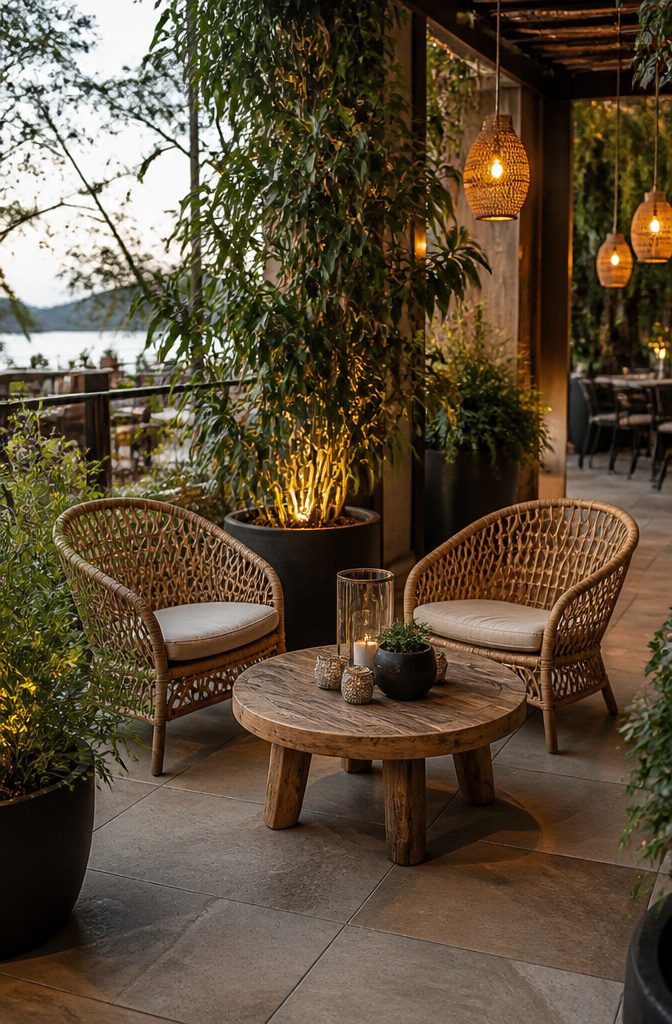
The corners that slow people down are the ones they remember. I learned that the hard way on a patio I set up two summers ago, where every seat faced the same open stretch and nobody stayed past dessert.
Intimate seating means breaking the rectangle: tuck a pair of chairs at an angle, add a low table that forces knees closer, and suddenly conversation lasts through a second drink.
Soft lighting does the heavy lifting after dark.
A lantern on each table reads as care without the cost of hardwiring, and string lights hung low enough to brush a shoulder replace that exposed feeling with something closer to a backyard dinner.
The sources disagree on whether spotlights belong; I skip them for anything smaller than thirty seats, because a beam on brick says stage, not stay.
Romantic corners work when they are hard to find from the entrance, not advertised. A half-screen of translucent drapes does this on a budget, filtering late sun by day and turning a single bulb into a glow by night.
The mistake is overfilling: one planter, one light source, and seating for two or three is enough to make a guest feel they discovered the spot themselves. That discovery is what brings them back.

Fit Size: Our garden bed measures 43.31*17.72*33.66 inches. cleverly designed to follow strict ergonomics. It allows you to tend to your plants without bending or stooping excessively, and will not put a burden on your back or knees.

[MINIMAL FOOTPRINT & MAXIMIZED SUNLIGHT] Save your valuable floor area! Designed to occupy very little ground space, this ergonomic trapezoid 5-tier vertical garden planter raised bed maximizes your growing capacity vertically. The smartly staggered structure ensures no plant is shaded, allowing every leaf to receive full sunlight and moisture. Whether on a narrow balcony or compact patio, this versatile vertical raised garden bed is perfect for harvesting fresh veggies, herbs, and blooms!

ARCH SUPPORT: WALK·HERO men slippers designed to address various foot problems and relieve pain, such as plantar fasciitis, flat feet, and heel pain; They also distribute pressure on your soles, improving your posture and gait in daily life
Reinforcing Place Identity Through Visual Design
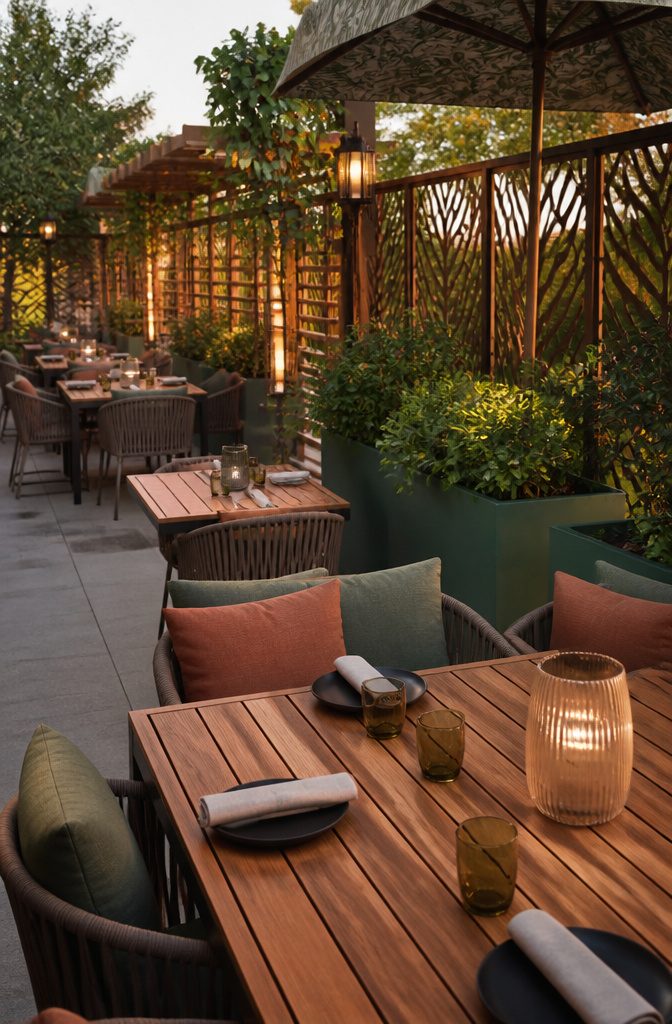
A terrace that looks assembled rather than designed usually has identity scattered across it: one logo color on the cushions, a different mood in the planters, a third personality in the menu boards by the door.
Customers sense the mismatch before they can name it. They walk past without the click of recognition that makes a place feel familiar enough to enter.
Consistency turns a terrace into an extension of the dining room.
Matching the outdoor palette to the dominant colors in the logo, repeating the same font or decorative motif on awnings and bench backs, carrying the interior’s material choices through to parasol fabric and tablecloth weight — these are the small decisions that make a customer recognize the establishment at a glance.
The fairy lights, the planter shapes, even the way furniture is grouped, all of it can express the same visual identity rather than defaulting to whatever was available.
When that coherence is missing, the terrace becomes a marketing tool that works against itself.
Passers-by see a space that looks temporary, and they assume the experience inside will match. A well-designed terrace is the first thing approaching customers see; it should signal that the place knows what it is.

Professional Hand Crafted: Room divider use environmentally friendly plant fibers. After special treatment, they are woven by workers by hand, which is natural and pollution-free.Make your home closer to nature.

High-Quality Materials: This 4 panel room divider is designed with upgraded to Oxford fabric, which is sturdy , waterproof and can give you more privacy. The frame is made of iron material, which is reliable and can make sure that the room divider won't fall. And there are 3 color options to match your home decor and create the ideal arrangement to meet your privacy needs.
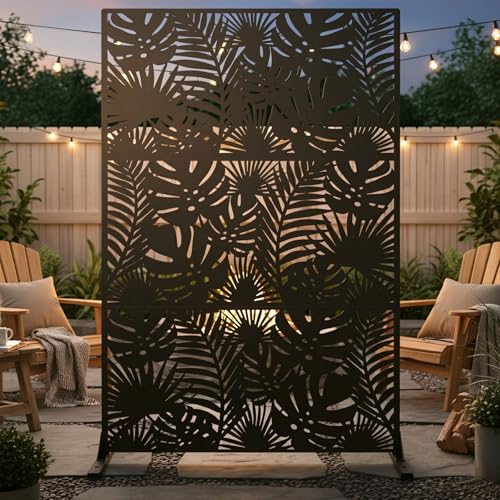
𝗢𝘂𝘁𝗱𝗼𝗼𝗿 𝗣𝗿𝗶𝘃𝗮𝗰𝘆 𝗦𝗰𝗿𝗲𝗲𝗻 𝗳𝗼𝗿 𝗣𝗮𝘁𝗶𝗼, 𝗚𝗮𝗿𝗱𝗲𝗻 & 𝗕𝗮𝗹𝗰𝗼𝗻𝘆:Transform your outdoor area with this decorative metal privacy screen. The 72x44in freestanding panel creates a modern garden divider that shields unwanted views while adding a contemporary touch to your patio, balcony, or backyard.
Vegetation That Structures and Calms
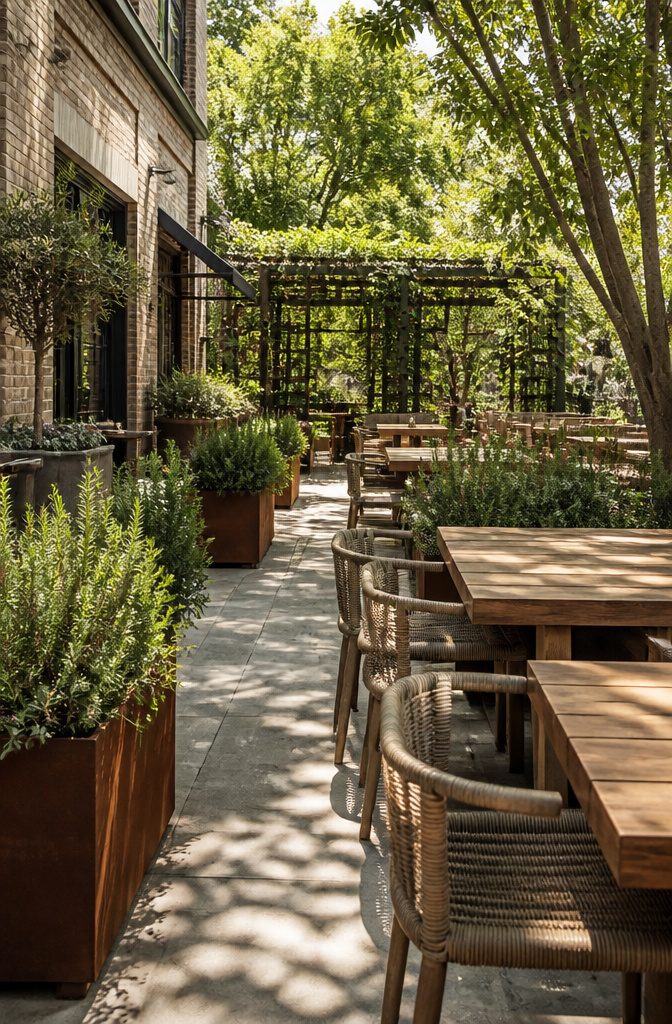
Local species suited to your exposure need less water and hold up to real weather, which is why they are the starting point for any planting plan on a terrace.
My own attempt split the difference between what I hoped would look lush and what actually survived: rosemary and thyme in waist-high planters lived through two summers with almost no attention, while a row of lavender I planted for the sensory hit near tables dried out in weeks because the afternoon sun was harsher than I had mapped.
Tall planters with built-in reservoirs would have saved the lavender, and they are worth the cost for any spot you cannot water daily.
The ones that lived now divide the dining area from a smaller aperitif corner without the closed-in feel of a wall.
Plants at shoulder height mark territory while keeping sightlines open, which matters more on a narrow terrace than on a wide patio.
A trellis with hanging climbers could have done similar work vertically, though I never tried it. The sources I read suggest it for wind filtering and hiding an unattractive view, both problems I did not have.
For midsummer freshness under a pergola, suspended planters are the move I would add next; the rosemary already proves that aromatic plants near tables shape the meal in a way decoration alone cannot match.

Sturdy and Durable: Package include 30 pcs clear adhesive christmas light clips. Base 1.57”x 0.9”, Inner Height 0.2”. The double-hook design and the use of high-quality PA66 materials make our string light hooks sturdy and durable, no worry about light clips for outside string lights falling off.

ONE LIGHT CLIP HOLDS ROPE LIGHTS UP TO 3/8-INCH THICK: One package of Command Clear Outdoor Rope Light Clips includes 12 clips and 16 small water-resistant Command Strips; one light clip holds rope lights up to 3/8-inch thick

[ STRONG ADHESIVE ] Our newly upgraded adhesive features ultra-high adhesion waterproof adhesive strips, solving the problem of falling decorations. It is easy to remove without leaving unsightly marks on walls
Small-Scale Interior Gardening
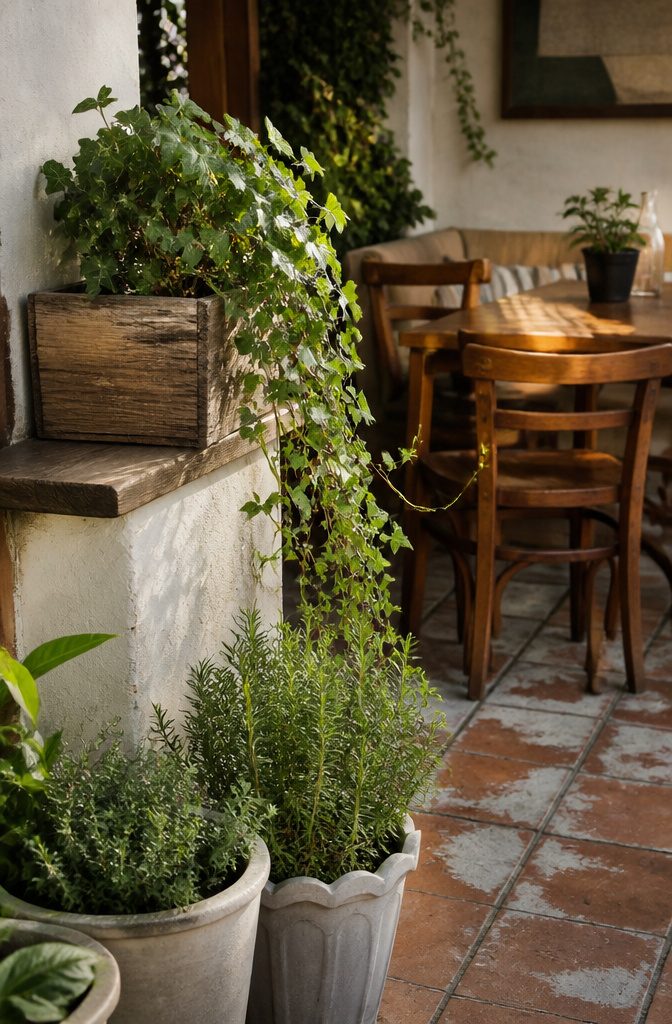
A single terra cotta pot with trailing ivy can do more for a terrace corner than a built-in planter ever did for my budget.
Self-watering inserts turn any cheap container into a low-maintenance option, which matters when you are hauling plants inside before frost and back out after the last freeze.
I learned that the hard way after losing two rosemary bushes to a sudden cold snap because I had not planned for mobility.
For renters, weight is the real constraint. A galvanized steel planter looks industrial and holds up to wind, but filled with soil it becomes furniture you cannot move.
I stick to lightweight resin pots that mimic stone, or simple wooden boxes lined with plastic sheeting. Both survive a season or two, and replacement costs less than the deposit you risk drilling into someone else’s deck for irrigation.
Herbs pay their own rent. A row of mint, basil, and thyme along a railing gives customers something to pinch and smell, and the kitchen uses what they do not.
The trick is keeping mint in its own pot; let it share space and it will bully everything else out by July. That judgment call, keeping herbs contained but present, is what separates decoration from maintenance headache.

SOOTHING WARMTH: Outdoor gas heater for cozy warmth when sitting outside; ideal for cafes, restaurants, and home patios

【Outdoor Propane Heater】The propane patio heater provides you steady comfortable warmth, press the button to ignite, no need battery. Featured a piezoelectric ignition and control valve to allow for temperature adjustment. It only takes a few minutes to get warm quickly, This heater is the perfect choice for outdoor and indoor use

Dual Safety Protection System: This outdoor patio heater features 45° anti‑tilt and flame‑out protection. The propane heater automatically cuts off gas supply when tipping over or accidental flame extinguishing, ensuring secure outdoor heating
Romantic Corners Without Overdoing It
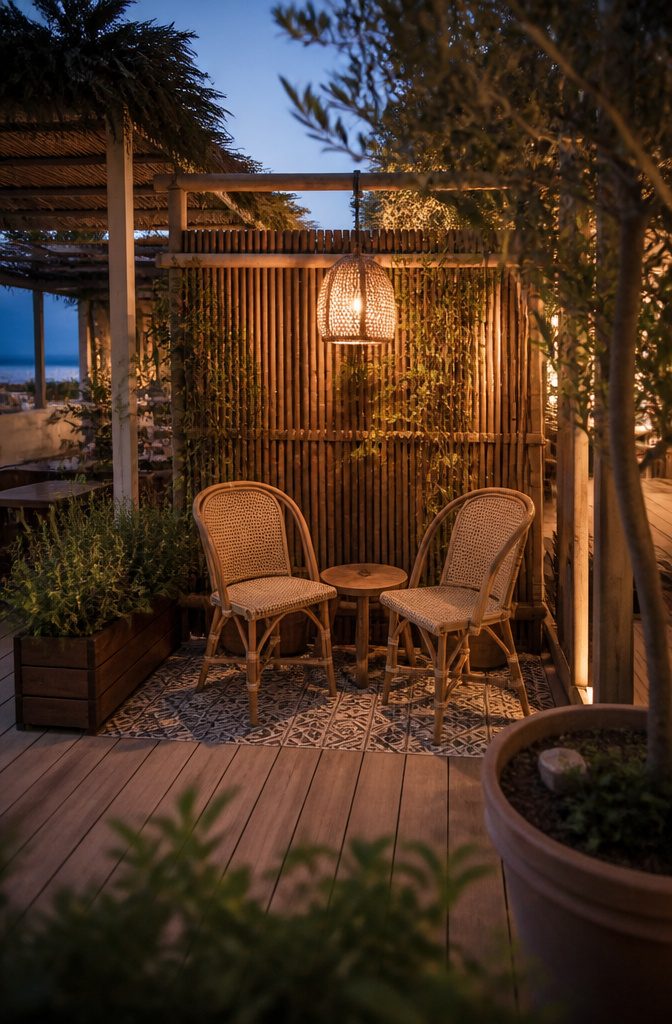
A single corner with a low bamboo screen and two cane chairs can read as romantic without turning the terrace into a maze.
I learned that the hard way after crowding three nooks into an eight-foot strip: servers had to thread between them, and guests felt watched rather than secluded.
One pocket of privacy per twelve feet of railing keeps the walkway open and the mood intact.
The one that worked sat at the far end of the west wall, where a half-canopy dropped the afternoon light to a softer glow and the bamboo broke the sightline from the main tables without blocking the server path.
Cane furniture kept it light enough to shift when the wind picked up, and a small tile patch underfoot marked the spot so staff knew not to drop an extra chair there.
Romantic corners fail when they fight the room’s real job, which is still to move drinks and plates through quickly.

All-Weather Protection for Everyday Outdoor Living: Built for real outdoor use, this patio chair cushion features water-resistant, tear-resistant fabric that stands up to light rain, sun, and daily wear. Ideal for porch, deck, garden, or backyard seating, it helps protect your outdoor furniture cushions so they stay looking great season after season

【About Size】Including 4 outdoor chair cushions measuring 19”W x 19”D x 3”T (Measure the seating area of your furniture to make sure the size of cushions is right). Our outdoor chair seat cushions are available in different colours and sizes suitable for outdoor chairs, dining chairs, sofas, and other different chairs. Ideal decoration for garden, patio, balcony, beach, and other indoor and outdoor scenes.

Fade-Resistant Outdoor Cushions – Solution-dyed fabric delivers rich, vibrant color that resists fading from harsh sun exposure and everyday wear. Designed to last longer and be replaced less often, these cushions stay bright season after season.
Keeping the Floor Plan Spacious
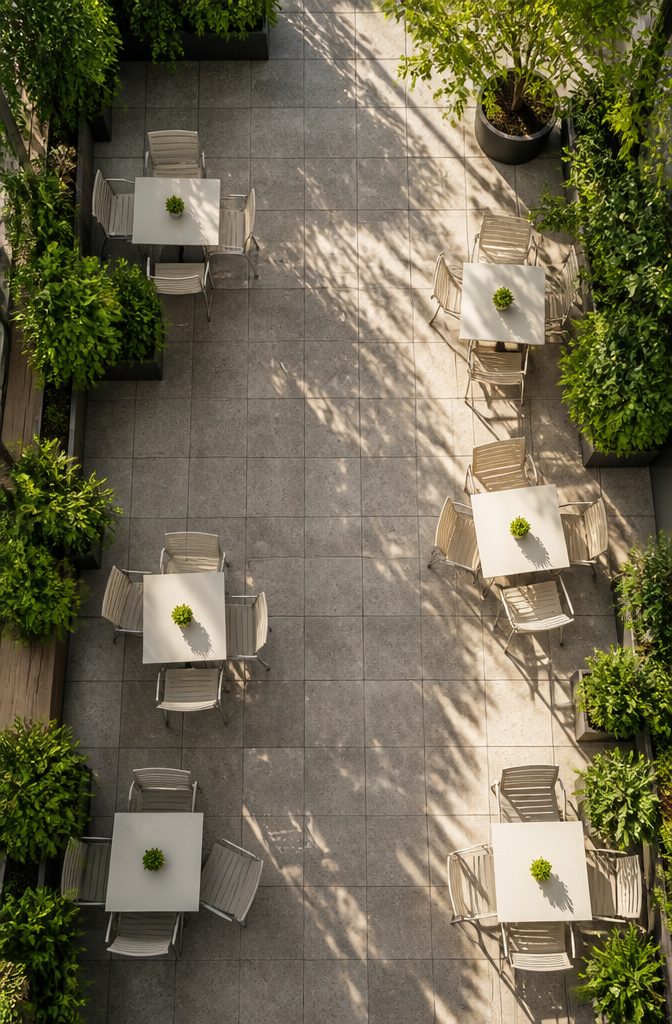
A narrow walkway between tables looks efficient on paper until a server with a tray meets a guest backing out of a chair.
I learned to treat floor space as furniture too. The passages call it out plainly: the terrace has to be spacious enough to walk through, to serve and to enjoy time, which means the measurement matters more than the mood.
I started checking clear width the same way, with a tape measure and a rolling cart loaded to the weight of a full dinner service. Thirty inches let one person pass.
Thirty-six let two brush past each other without negotiation. Forty-eight, and a server could swing wide around a chair without breaking stride.
The number that stuck was thirty-six: below that, every arrival and departure became a choreography problem, and the comfort the furniture promised got eaten by the squeeze between tables.
The sources favor varying table sizes, small ones for two up to six- or eight-tops, which only tightens the math.
Each large table needs breathing room on all sides, not just the approach. I laid out my last terrace with two-foot chairs pushed back in every direction, then added that to the table footprint.
The total decided placement, not the table alone. Lightweight aluminum or cane pieces help here; they shift for large parties and reset without a crew, which turns fixed square footage into flexible square footage.
Stackable chairs buy back space at close, but the daily layout still has to earn its keep during service. The mistake I made once was packing in one more two-top where a thirty-inch gap had been.
That corner stayed empty most nights, not because the view was bad, but because diners felt the draft of every passing body. I pulled it the following week and never repeated the error.
Semi-Covering Options for Weather Protection
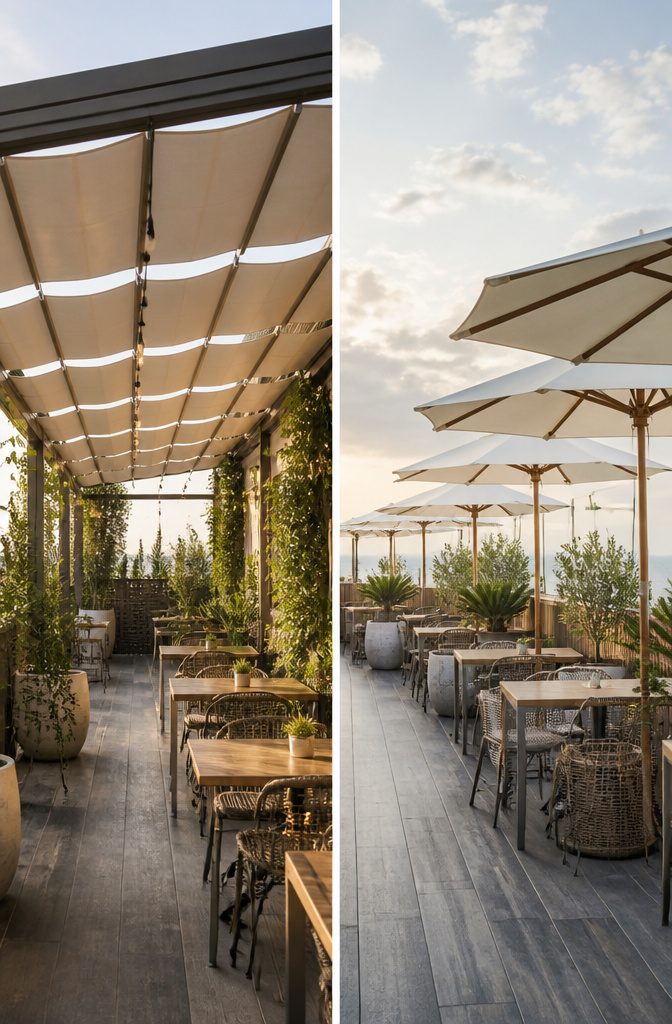
A full cover over the terrace sounded like the smart move last spring. I priced out a fixed canopy with solid sides, enough to block sun, wind, and rain in one shot.
The quote came back steep, but the real problem showed up in the mock-up: the space underneath went flat and garage-like the moment the last panel dropped.
Customers walked in, looked up, and kept walking to the open tables by the railing.
Semi-covering options won because they protect without that deadening effect.
A retractable canopy over the main dining area stops direct sun and light rain, but gaps at the sides let air move and keep the terrace feeling like part of the street.
Side awnings that roll down only when needed do the same job for wind without walling anyone in.
I added a pair of standard street umbrellas over the two-person tables for about $180 each; they tilt, so guests adjust their own shade through the afternoon.
The constructed canopy I almost bought would have run closer to eight thousand and stayed up year-round, collecting leaves and sagging under snow load.
The lighter setup breaks down in twenty minutes if a storm rolls in, and the furniture underneath is already outdoor-rated for humidity and UV anyway.
One heater under the canopy edge, aimed at the center aisle, stretches usable evenings from April into October without changing the openness that sells the seats.
Lightweight Furniture That Moves
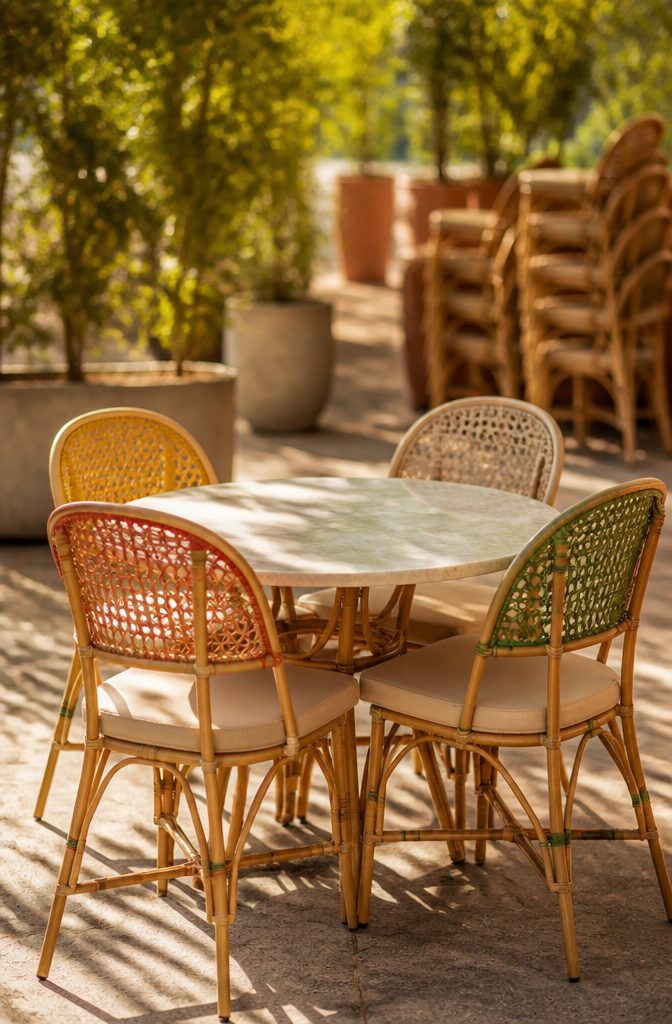
Cane and bamboo earn their place on a terrace for one reason above all: one person can shift a six-seat setup before the lunch rush and stack the chairs in a corner by closing time.
Aluminum manages some of that lightness, but the natural materials carry a warmth that metal rarely matches without doubling the cushion budget.
The tradeoff shows up fast. Bamboo takes water damage if it sits in pooled rain, so it needs a covered spot or a nightly haul indoors.
Rattan handles moisture better but frays under heavy daily use; I would not put it at a table that turns three times on a Saturday.
For a terrace that reconfigures between brunch service and evening seating, the weight savings matter more than the lifespan. A server moving twelve chairs in ten minutes versus twenty changes how flexible your floor plan actually is.
Earthy-toned cushions on these frames tie back to the foliage and hanging baskets without competing for attention. The colors calm the space rather than shouting over it, which matters when every wall already carries vertical plants or suspended blooms.
Flooring That Grounds the Space
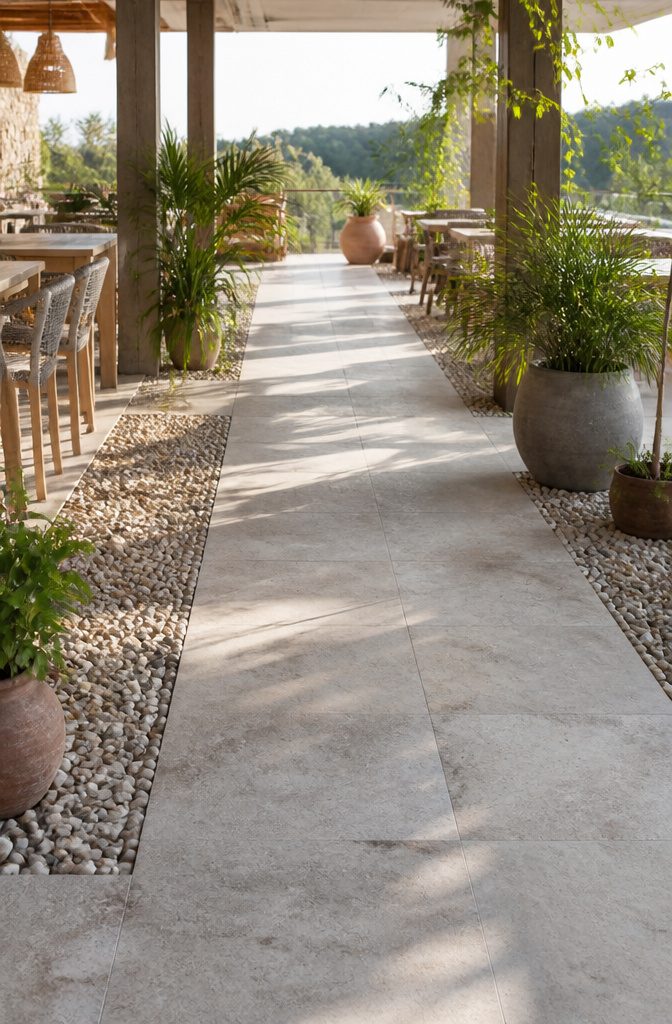
Pebbles can define a dining zone without a single tool, but the wrong size turns an ankle. I learned that reading through terrace builds where 3/4-inch river stone stayed put under chairs and anything smaller scattered like marbles underfoot.
Loose pebble needs an edge restraint, steel or concrete, or it migrates onto the tile you paid to keep clean.
Porcelain tile rated for exterior use handles freeze-thaw cycles; standard ceramic does not. The stained concrete I once admired in photos showed hairline cracks within two seasons where a sun-drenched terrace met shade.
Sealer buys time, maybe two years, before the gray mottles with wine and grease. Epoxy grout over sanded grout costs more upfront and repays it the first time you scrub tomato sauce out of the joints.
A surface treatment that worked: exterior-rated deck tile laid directly over existing concrete. No adhesive, no demo, lifted in twenty minutes if the landlord notices.
The ones with interlocking tabs warped less than snap-together versions. Heat reflection matters more than color charts suggest; light gray stayed walkable at 2 p.m. in July, charcoal did not.
Compact Bar Counter Nooks
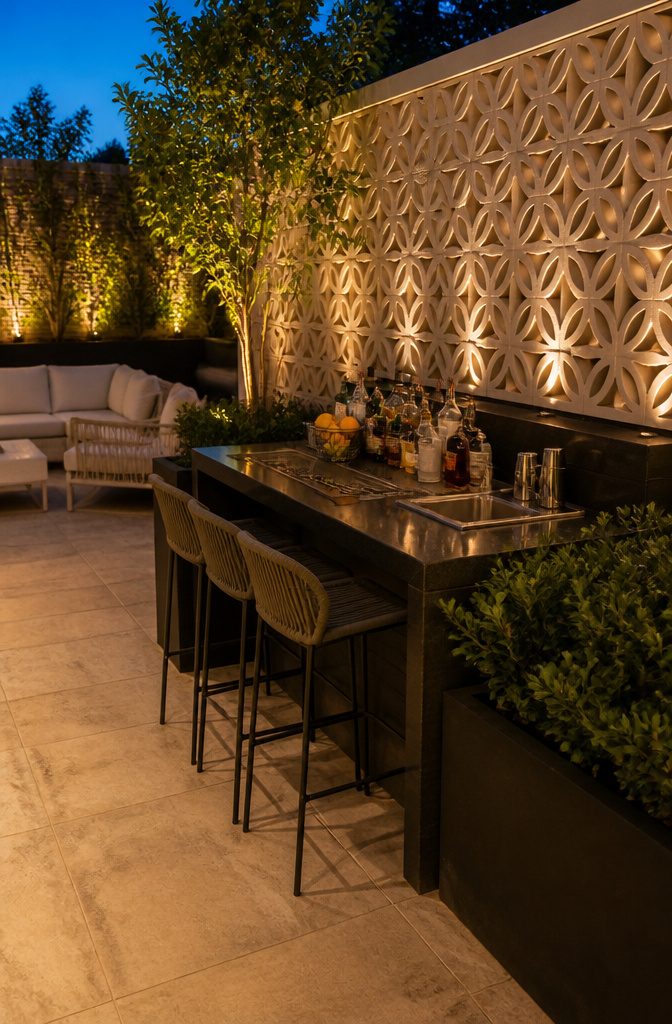
A compact bar counter tucked against the terrace wall does more than look tidy; it fixes the traffic pattern that kills service on busy nights.
When I laid out a friend’s rooftop setup in Queens, the counter was 42 inches deep and 72 inches long, just enough for an ice bin, a three-tap tower, and a small rail of bottles without crowding the bartender’s backswing.
That depth mattered because anything under 36 inches forced everything into a single row, which meant the server had to circle around for every pour instead of working a tight U-shape.
The circulation gap on the guest side was tighter than most guides suggest, about 24 inches from stool face to the nearest dining chair.
Sources call for more room between tables for easy movement, but at a bar you want the slight compression; it signals this is a stop, not a seat for dinner, and it keeps the aisle behind open for servers running food.
Planters on the terrace edge separated the bar zone from the lounge without a wall, so the space still read as one open area.
The stools stayed light enough to stack, because the furniture had to clear out fast when weather turned.
Artistic Accents That Stay Subtle
Most of the terrace restaurant decoration guides I came across pushed artwork hard: gallery walls, statement sculptures, the whole narrative.
I looked at the cost and the upkeep, then I looked at the wind and the pollen on an actual terrace, and I parked almost all of it.
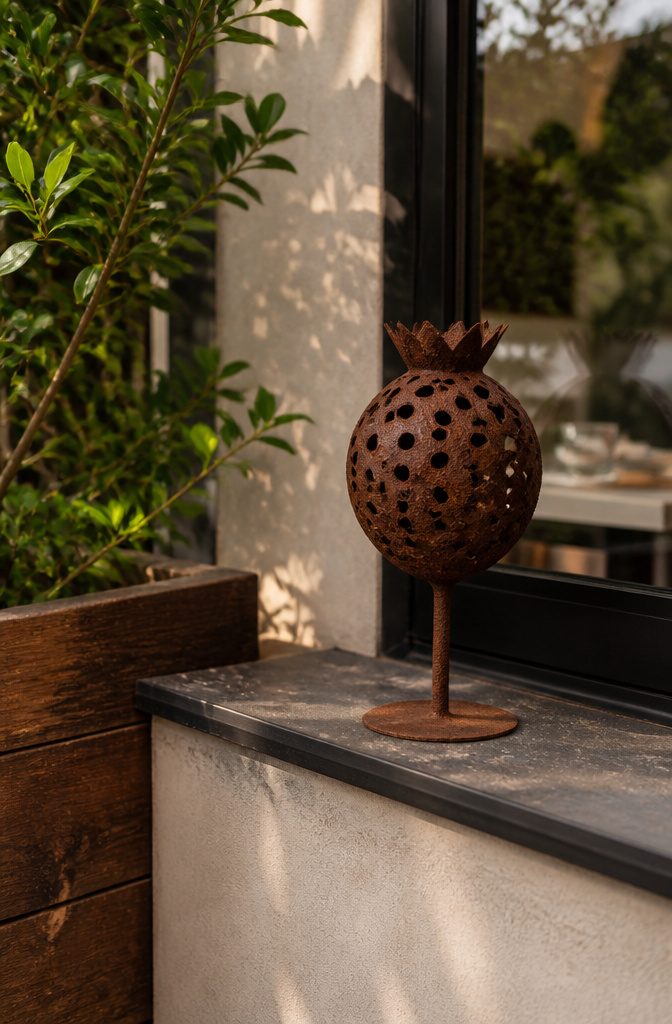
What stayed was one piece, and only because it was built for this. A local metalworker had a small weathered-steel sculpture, maybe two feet tall, shaped like an abstract seed pod or a folded leaf.
It sits on a narrow concrete ledge where a wall meets the railing, low enough that diners notice it on the way in but never have to look around it to talk to each other.
Steel weathers to a dark rust-brown that already matched the planters, so it did not read as "art object dropped from above." It read as something that grew there.
The rest of the artistic accents I skipped for two reasons. Wall-mounted pieces need hardware rated for wind load, and most framed work traps moisture behind glass.
Sculptures with small pedestals become drink rests or trip points in tight seating. The sources that mention working with regional artists are right about community connection, but they rarely mention the insurance question or the nightly cover-or-carry ritual.
One piece, chosen for material and scale, gives the terrace a sense of intention without the maintenance overhead. Two feet tall, weathering steel, tucked low against a wall: that is the ratio that survived a full season.
Water Features I Considered and Rejected
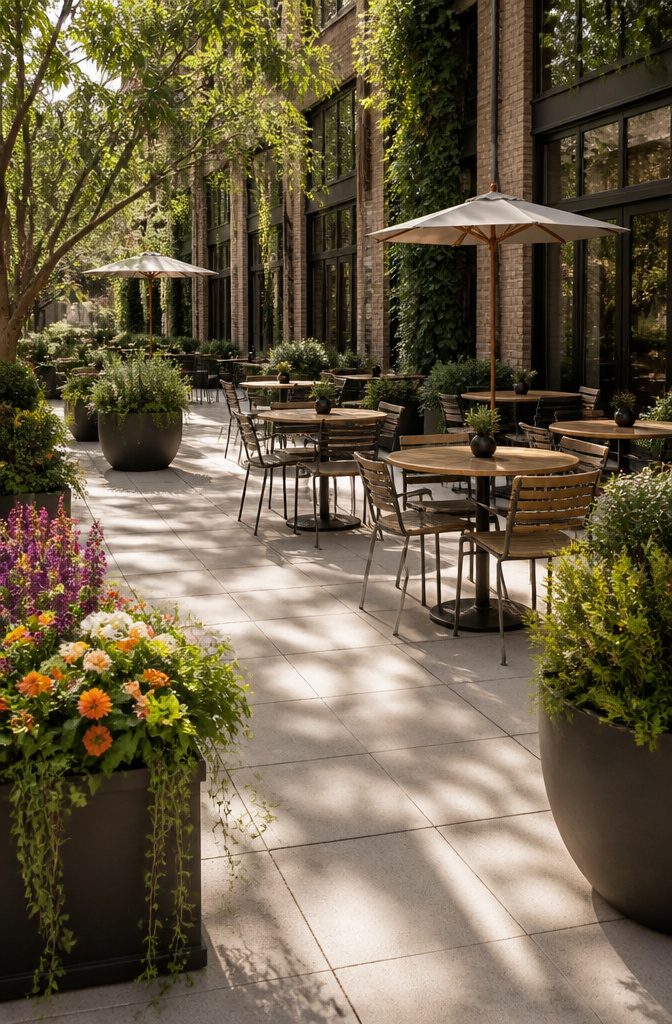
A small fountain was the first thing I pictured when I started planning the terrace.
The sound of running water, something cool against the summer heat, it all felt right for outdoor dining. Then I looked at what keeping one clean actually takes.
Standing water turns a terrace into a mosquito hatchery within days.
In most states, that’s not a seasonal problem, it’s a May-through-October commitment to either chemicals or constant draining. The pump needs clearing, the basin needs scrubbing, and the whole thing demands attention on a schedule no weekend project should have.
The sound helped me rationalize it for longer than it should have. I played a recording of a small spillover fountain through a speaker one evening to test the effect.
Guests talked louder over it. The recording went off after twenty minutes and nobody reached for the volume.
For the cost of even a modest recirculating kit, you could buy two years of decent outdoor speakers and still have change for the electricity.
The speakers move inside in October. The fountain would have stayed out, freezing, cracking, becoming a job for spring.
What I Skip and What I Do Instead
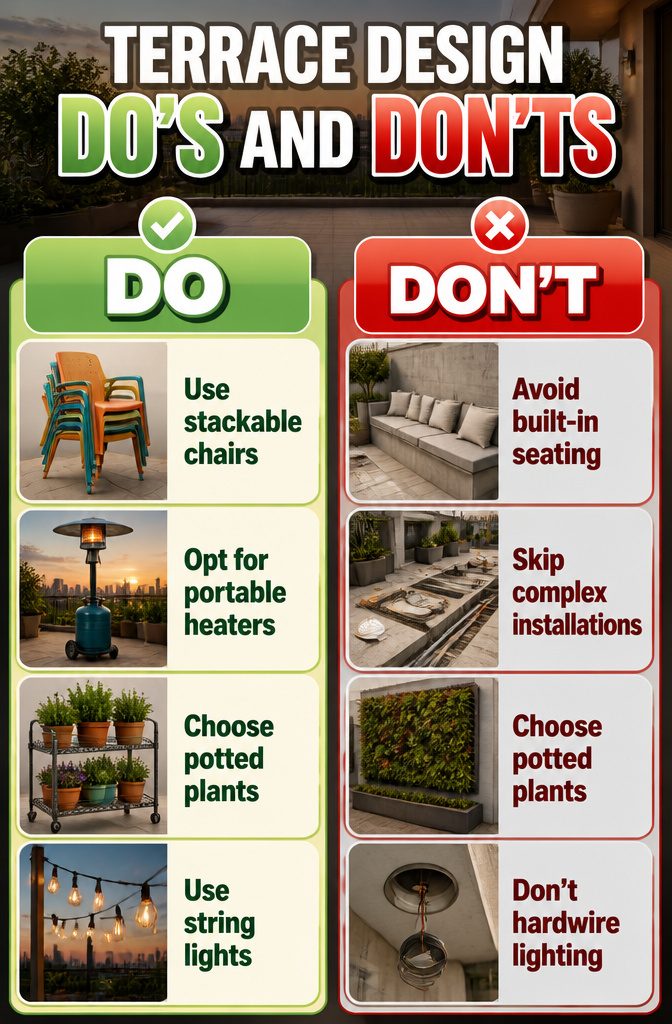
Designer showcases and permanent installations are where terrace budgets go to die.
The pieces that look effortless in a magazine usually arrived on a crane and live under a maintenance contract. A few things leave my list immediately.
Built-in seating with custom cushions. The frames crack, the fabric fades, and the next tenant inherits your mistake.
Stackable chairs with washable covers replace them every time. Swap the covers for $30 instead of rebuilding the box.
Anything requiring a permit or a contractor. Gas lines, poured concrete, electrical trenches: the permitting timeline alone kills a weekend project, and the labor cost triples whatever you budgeted.
Portable propane heaters and freestanding planters do ninety percent of the same work with zero phone calls to the city.
Living walls and vertical gardens.
The irrigation fails, the plants drop leaves into dinner plates, and the waterproofing bill arrives six months later. Potted herbs on a rolling steel rack give the green effect, move for cleaning, and die cheaply if you forget them.
"Statement" lighting hardwired overhead.
Sockets get wet, bulbs break, and an electrician charges holiday rates to replace either. String lights on guide wire, plugged into outdoor-rated outlets: same glow, swapped in ten minutes with a stepladder.
Materials That Failed and What Replaced Them
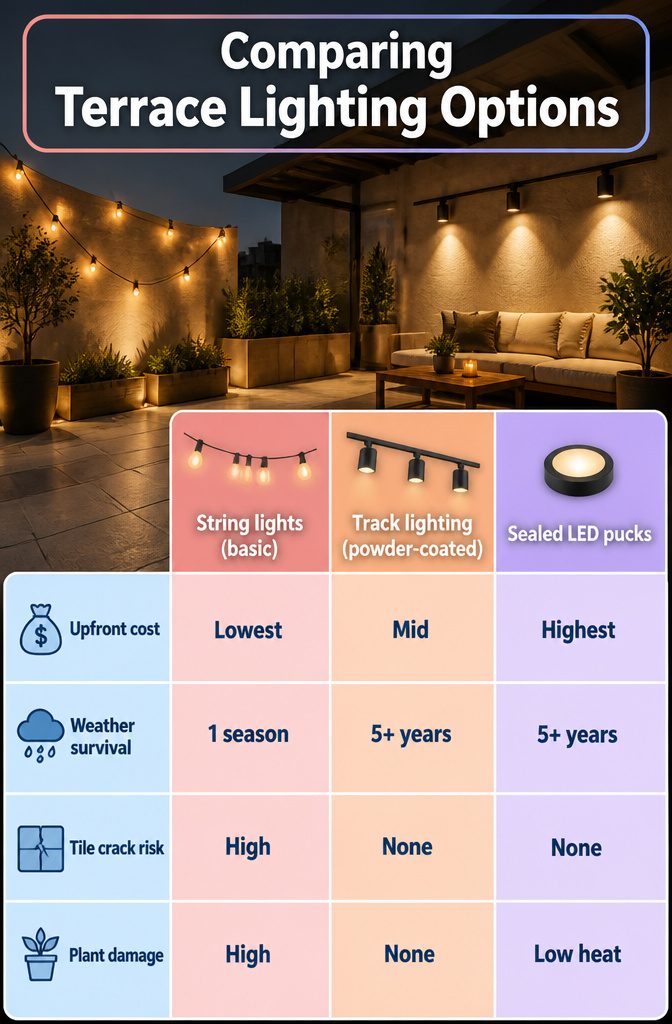
Pinterest boards love draped café lights across every terrace photo, but the galvanized wire housing on cheap string lights corrodes in coastal humidity within a single season.
I swapped to powder-coated aluminum track lighting and never replaced a housing again. Same warm glow, zero rust streaks down the wall.
| Feature | String lights (basic) | Track lighting (powder-coated) | Sealed LED pucks |
|---|---|---|---|
| Upfront cost | Lowest | Mid | Highest |
| Weather survival | 1 season, coastal | 5+ years | 5+ years |
| Tile crack risk | High (hanging hardware) | None | None |
| Plant damage | Heat + shock from broken bulbs | None | Low heat |
Cracked tile came from freeze-thaw on unsealed terracotta.
Porcelain rated for exterior use costs more per square foot but survived two winters without a chip. The plants that died were container rosemary and lavender, root-bound in too-small pots that overheated on concrete.
Self-watering planters with reservoir trays and a 2-inch mulch layer fixed that. Skip the unsealed terracotta anywhere frost happens.
Frequently Asked Questions
What are some tips for designing an outdoor restaurant terrace?
Divide the terrace into distinct zones using planters, light screens, or trellises so different party sizes each feel the space suits them.
Choose weather-resistant materials like teak, powder-coated metal, or aluminum, and keep lighting soft with covered fixtures rather than exposed string lights.
Plan for year-round use with strategic heater placement and retractable canopies rather than fixed covers, and maintain at least 36 inches of clear aisle width so staff and guests move without conflict.
How can I create a romantic atmosphere in a terrace restaurant?
Limit intimate corners to one per twelve feet of railing so servers can still move freely.
Tuck seating at an angle with a low table that brings knees closer, and use soft sources like solar lanterns or table candles rather than spotlights, which read as stage lighting.
A half-screen of translucent drapes filters sun by day and diffuses a single bulb into glow by night, letting guests feel they discovered the spot themselves.
What types of furniture are best for outdoor dining?
Teak lasts longest but needs maintenance to keep its color; aluminum costs less and moves easier, which matters for closing routines.
Cane and bamboo weigh almost nothing and warm the visual field, though they need dry storage and suit lower-traffic tables.
Stackable chairs save storage space and time, and keeping frame finishes consistent prevents the terrace from reading as mismatched. Cushions must be moisture-resistant or they become a nightly storage burden.